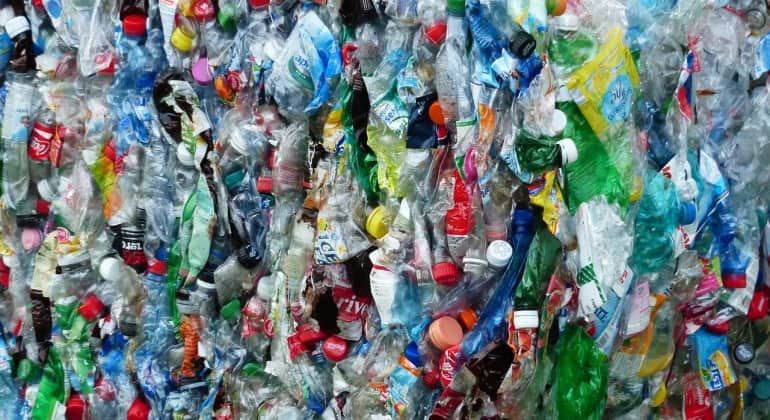
The plastic, once collected , is pressed in order to facilitate its transport to the plants that deal with the selection and recycling of the same plastic. The latter is then sent to sorting and recycling centers or to compaction centers.
What happens to plastics in recycling plants?
Once the plastic reaches the recycling plant , it is inserted into a special plant which tears any collection bags.
The first selection of mechanical plastic types takes place in a rotating screen that separates the various families of plastics based on their size.
Following this first mechanical separation which is carried out by the rotating screen, further separations occur by optical readers, which separate the plastic on the basis of the polymers of composition and any colors. In this case, the separation does not occur with a rotary movement but with puffs of air. At this point, a second compression with storage takes place where homogeneous packages are formed, given by the same types of plastics.
In addition to the mechanical divisions there are also those manual in which the plastic passes on a conveyor belt and the workers remove any plastic materials that are not suitable for recycling. An example of this is plastic toys that are incorrectly disposed of in the separate plastic collection.
The main stages of plastic recycling
The limit of plastic recycling lies in the first phase, which is the one that concerns the collection.
In Italy, compared to 450 thousand tons of plastic available every year, only 180 thousand must be returned to the recycling cycle . The machines available on the Italian territory (about 40 plants) can process only two of them every year.
The main stages of plastic recycling are as follows:
- Recycling
- Storage and compaction
- Transfer to the selection centers
- Tearing of any container bags
- First mechanical selection where the discriminating factor is the size of the plastics
- Second selection given by optical readers in which the discriminating factor is the type of plastic
- Compaction and storage of bales made of homogeneous plastic material: PET, high density polyethylene and low density polyethylene
- Reuse of plastic as a secondary raw material.